오키나와의 별모양 모래
It’s all in the name: Hoshizuna no Hama, or Star Sand Beach, located on Taketomi Island in Okinawa, Japan, is filled not with sand made up of rocks and minerals, but instead with microscopic star-shaped particles. These tiny particles have no relation to the stars in the night sky, nor to the starfish that often wash up on shore with them.
일본 오키나와 다케토미 섬에 위치한 호시즈나노하마(별모래해변)는 암석과 광물로 이루어진 모래가 아니라 미세한 별 모양의 입자로 가득 차 있습니다. 이 작은 입자들은 밤하늘의 별이나 해안으로 밀려오는 불가사리와는 아무런 관련이 없습니다.
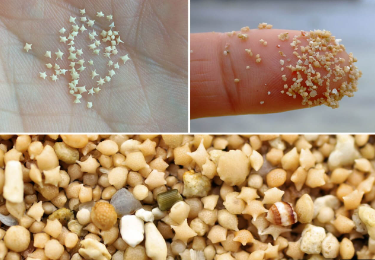
Star sand is actually the remnants of tiny organisms, a group of animals belonging to the subphylum Foraminifera. Each little star is the exoskeleton of small, single-celled organisms known as Foraminifera. Their scientific name is Baculogypsina sphaerulata, but marine biologists call them “living sand,” although technically the discarded exoskeletons of the microscopic animals that wash up by the millions on shore are just the dead remains.
별모래는 사실 유공충아문(subphylum Foraminifera) 에 속하는 동물 그룹인 작은 유기체의 잔해입니다. 각각의 작은 별은 유공충(Foraminifera)으로 알려진 작은 단세포 유기체의 외골격입니다 . 학명은 Baculologypsina sphaerulata 이지만, 해양 생물학자들은 그것을 "살아있는 모래"라고 부릅니다. 수백만 마리가 해안으로 떠밀려온 미세한 동물의 버려진 외골격이 단지 죽은 잔해일 뿐이지만 말입니다.
One of the rarest forms of sand, star sand, is both a beautiful sight and a scientific marvel. Found on the Taketomi, Hatoma, and Iriomote islands of Japan, star sand is exactly what the name implies — small, millimeter-sized pieces of sand in the shape of stars. At first glance, the beaches look like any other. Only when visitors take a closer look at the beach they stand on does it become clear that this is no ordinary sand. Despite the small size of the sand particles, beach-goers have no problem seeing this incredible five-pointed star shape with the naked eye.
가장 희귀한 형태의 모래 중 하나인 별모래는 아름다운 광경이자 과학적 경이로움입니다. 일본의 다케토미, 하토마, 이리오모테 섬에서 발견되는 별모래는 이름 그대로 별 모양이고 작은 밀리미터 크기의 모래 조각입니다. 언뜻보기에 해변은 다른 해변과 비슷해 보입니다. 방문객들이 해변을 자세히 들여다보고 나서야 이것이 평범한 모래가 아니라는 것이 분명해집니다. 작은 크기의 모래 입자에도 불구하고 해변을 찾는 사람들은 육안으로 이 놀라운 별 모양을 보는 데 아무런 문제가 없습니다.
Unlike most beaches, the sand on Hoshizuna Beach and other surrounding Japanese beaches is made up not of rocks and minerals, but rather of the remnants of previous organisms.
As the waves roll in on the beach, the water carries with it the shells and exoskeletons of these tiny organisms, constructing the unique shoreline. This particular, star-shaped species of Foraminifera, known as Baculogypsina sphaerulata, is found only in the coral reefs of East Asia, making this special sand shape one of the rarest in the world.
대부분의 해변과 달리 호시즈나 해변과 주변 일본 해변의 모래는 암석과 광물이 아니라 이전 유기체의 잔해로 구성되어 있습니다.
파도가 해변에 밀려오면 물은 이 작은 유기체의 껍질과 외골격을 함께 운반하여 독특한 해안선을 형성합니다. Baculologypsina sphaerulata 로 알려진 특별한 별 모양의 유공충(Foraminifera) 종은 동아시아의 산호초에서만 발견되며, 이 특별한 모래 모양은 세계에서 가장 희귀한 것 중 하나입니다
Take a stroll along Hoshizuna no Hama (Star Sand Beach), located on Iriomote Island, and your feet will become encrusted with tiny star-shaped "tests," or shells, produced by microscopic, unicellular protists known as Foraminifera. When Foraminifera die, their shells remain in the sea and the tide brings them ashore. In the case of Hatoma, Iriomote and Taketomi islands in Okinawa, this results in beaches sprinkled with star sand.
이리오모테 섬에 위치한 별 모래 해변을 따라 산책하면 유공충으로 알려진 미세한 단세포 원생 생물에 의해 만들어진 작은 별 모양의 껍질로 뒤덮입니다. Foraminifera가 죽으면 껍질은 바다에 남아 있고 조수는 그들을 해변으로 데려옵니다. 오키나와의 하토마, 이리오모테, 다케토미 섬의 경우 별 모래가 뿌려진 해변을 만듭니다
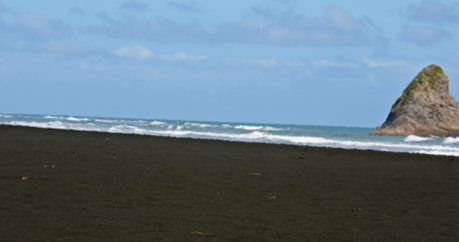
When we think of beaches, we tend to imagine only one type of sand, but there are interesting types of sand around the world, in addition to Japan’s star sand. On Hawaii’s Papakolea Beach, its olivine sand is made up of crystallized magma, and the whole beach is green. California’s Pfeiffer Beach has one of the only locations dominated by garnet sand, meaning entire sections of its beach are purple. New Zealand’s Muriwai Black Sand Beach is made of darkly colored volcanic glass.
우리가 해변을 생각할 때 한종류의 모래만을 상상하는 경향이 있지만 일본의 별모래 외에도 전 세계에는 흥미로운 종류의 모래가 있습니다. 하와이의 Papakolea Beach 에 있는 감람석 모래는 결정화된 마그마로 구성되어 있으며 해변 전체가 녹색입니다. 캘리포니아의 파이퍼 해변(Pfeiffer Beach)은 가넷 모래가 있는 유일한 장소 중 하나입니다. 즉, 해변 전체가 보라색입니다. 뉴질랜드의 무리와이 블랙 샌드 비치는 짙은 색의 화산 유리로 이루어져 있습니다.
 홈 > 영어컨텐츠 > Today's Issue